Wednesday, March 21, 2018

Annotation #4: Western


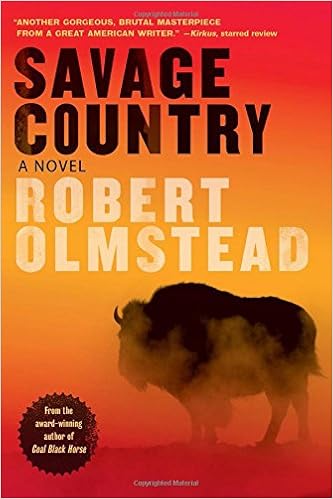
Image result for savage country by robert olmstead

Savage Country

by Robert Olmstead

Release Date: September 26th, 2017

Genre

Western

Appeals of the Book

Strong Characters
Richly Detailed
Dramatic Situations

Synopsis

Michael Coughlin returns to Kansas to attend the funeral of his brother, David. Michael’s sister-in-law, Elizabeth, wishes to go south on a major buffalo hunt her husband had planned to earn his family a fortune. Michael assists Elizabeth on this expedition, with the help of several friends and hired workers, but where they go is a savage land where you risk your life. Beware not just the animals, but the people you meet as well. Who are the real animals among them? 

Characteristics That Fit Into Western
  • Setting is the Great Plains of the West in the time period between 1865 and 1900.
  • Storyline involves buffalo hunting, but at the same time trying to survive in the harsh West and has a sense of resolution (Saricks 318-319)
  • The hero “arrives to right wrongs” (Saricks 315). However, the hero’s motives go beyond this traditional aspect. He wants to use his skills to help family, using “strategy before guns to win arguments” (Saricks 315). Saricks explains that some main characters have a mythic aspect to them, which this main character has because he has been all around the world and has so many skills that he can do almost anything and knows almost anything. (Saricks 316-317).
  • Reflections on the past, both good and bad, are present. Therefore, it has a bit of nostalgic tone, but features a dark tone at time (Saricks 320).
  • Rich details of the western landscape.
  • Midway between leisurely and fast-paced. Not too much action happening.
Read-A-Likes

The High Divide by Lin Enger*

The Last Crossing by Guy Vanderhaeghe*

Mudbound Hillary Jordan**

Devil's Dream by Madison Smartt Bell**

* Recommended by NoveList
* Recommended by Kirkus Review

Works Cited

Saricks, Joyce G. The Readers' Advisory Guide to Genre Fiction. Chicago, IL: ALA, 2009. 

Monday, March 5, 2018

Book Club Experience

The benefit of working at a library and working on my MLS is that many assignments I work on correlate directly with what I do already, as well as ideas and projects I plan to do at the library. That being said, this assignment lined up with my ambition to start a book club for teens. I do not want to do a book club where everyone reads the same book. I prefer open book chats. You do not have to worry about reading a book you may not like. Most of the book clubs hosted by the library or advertised by the library are book chats that promote people discussing what they are reading rather than reading a single book. Open book chats also have the ability to feature books that you have never heard of before. There is a book club at a branch I used to work at hosted by patrons, and they usually do what is popular. This is of course great for those authors. As the article “Read Well with Others” by Bill Goldstein states, “a title popular with book groups has an extended life, and sales may even increase over time” (Goldstein). I rather hear about books I would never think to pick up or ever see lying around.

The book chat I participated at for this assignment was one of the library branches that hosts a book chat every first Monday of the month. I let the branch manager and book chat leader know I will be attending and that I wanted to shadow so I can learn how to set up a similar program for teens. I was told the majority of those who attend this book chat are retired women, and most are regulars to the book chat.

The person and leading the book discussion was a library assistant who worked at the branch. This book chat was different than her normal ones because she had a guest speaker from IU South Bend come and speak about a few of the books she has written. Because of this special guest, we did not get to the actual book chat until about 45 minutes later. It’s only an hour program but it went on for about 75 minutes due to the guest. However, the guest sparked much discussion among the attendees during her time. Besides asking about how the author wrote her books, they asked questions about the books themselves. A couple of the attendees had read the book and shared their thoughts on the book. One attendee mentioned how she loved the book because it tackles the issue of women not being allowed to have the voice they want, and that the book was such a fun, easy read. This sparked a mini discussion about this topic today.

            After the guest speaker was finished, the leader opened the floor to anyone who wanted to share what they have been reading. An awkward few seconds went by before anyone said anything. The first attendee to speak up discussed a recent novel by Jonathon Kellerman. Another attendee who also recently read a few of his books chimed in, and somewhat overpowered the discussion. After the discussion on that first book was over, that same patron who overpowered the discussion said, “Well, since I am talking I guess I’ll go next.” She mentioned how, besides also reading Kellerman, she read a book called Pax by Sara Pennypacker. She said she purchased it thinking it was an adult novel, but later realized it was for kids. I was delighted to hear this because this is a book I read back in S571 Materials for Youth. I was able to chime in by saying I also read it, as well as what I thought about the book. I was worried I would have nothing to add to the discussion since I am not a huge reader at the moment. I followed up by mentioning another great children’s book for adults is The War That Saved My Life by Kimberly Brubaker Bradley. This same women at the end of the book chat also asked if anyone read The Women in the Window by A.J. Finn. Again, I was excited to hear this because I just read that book for this class two month ago! She asked me if it was worth finishing, to which I replied that it was because the intensity builds and it will be made into a movie, so it’s great to read it now before everyone else starts to read it.

The leader was very good about moving the discussion along, asking if anyone else had a book to share. When the guest speaker was there, I could tell the leader did her best to wrap up her time because she did speak longer than the leader had planned. Of the 10 or so people there, about 7 participated. I noticed that everyone did not bring a book to discuss, so I imagine people come to listen to what others are reading. As Bill Goldstein states, “clubs have become a potent network, organized loosely by their shared need for information about the books they are reading and for suggestions on what to read next” (Goldstein 32). I heard interesting stories about several books that I probably never would have heard about or considered.

 The leader participated when she had something to add, but she let people freely discuss whatever was presented. People mainly spoke about what they liked about the book they brought to discuss, and people agreed or disagreed with their statement. It was all very friendly even if someone did not like a book mentioned. That being said, the atmosphere was extremely friendly and stress-free. You can tell these women got to know each other through the book chat, and it was essentially a fun hangout.

Snacks and drinks are not provided at this book chat. However, she does have two tables set up as one long table to hold reading recommendations and library promotional materials. They appear to talk about any book, whether it’s fiction or nonfiction. The host takes notes about books discussed at the meeting, and then pulls a bunch of these books to be displayed at the next meeting. She also has a copy of her notes available for people to take home. Overall I had a great experience! When I complete my studies in May I hope to read more and to join a couple book discussions my library features.  

Works Cited

Goldstein, Bill. "Reads Well with Others." Publishers Weekly, vol. 252, no. 21, 23 May 2005, pp. 30-34. EBSCOhost, search.ebscohost.com/login.aspx?direct=true&db=lxh&AN=17114088&site=ehost-live.
Saturday, March 3, 2018

Special Topics Paper Summary - Readers' Advisory Forms Developing Readers and Library Staff

My personal experience with Readers’ Advisory (RA) began when I started working the frontlines in April 2016 as a Library Technician whose job was to assist with technology questions, but I primarily worked the desk doing both reference and circulation duties. At that point I was not much of a reader, and I had minimum training with NoveList. I completed a year-long RA course required by all frontline staff in 2016, and even then I was not confident in my RA skills. In June 2017 I was asked by a member of the Readers Advisory Committee to help assist with online RA requests through our Next Great Read service. Through this service patrons can fill out a form online describing their interests, recent reads, and favorite book appeals. The form is sent to the committee, which is then distributed among the committee members and additional staff like me. I am the only person in this group who does not have their MLS or highly significant RA experience, but they trust my experience enough for me to assist. I trust myself enough to do a great job, and I enjoy doing the forms. You do not have to be a professional with a degree to offer quality RA service. As Mary K. Chelton, Associate Professor at Queens College, says in the article “Readers’ Advisory 101,” “One of the biggest myths is that a librarian must have read a book to suggest it, without resorting to any reference sources” (Chelton). However, I will argue that the type of RA service, combined with the library setting and how busy it is at any given moment, could have an effect on the quality of service provided. I believe all libraries should offer an online or physical RA form to be available for patrons that would like their library to find their next great read, because this process allows librarians to think through their RA process and to build experience, as well as for readers to think about their own reading interests more deeply.

Traditional, in-person, RA services can be hectic depending on how busy a library is at any given moment, combined with the experience of the library staff. Some staff do not have the ability to walk around and read inside covers of books to familiarize themselves with titles. Even if a staff member can do this, it can become busy at any moment, or a patron may become impatient. Neil Hollands writes in Reference & User Services Quarterly, "When RA is rushed, results become haphazard” (Hollands 206). Having physical RA forms, or bookmarks with the online form information, would be a great promotion for RA services. Staff at service desks can hand patrons these items, as well as trying to find a book for them while they are there. 

Readers’ Advisory services through library chat is almost the same situation as in-person RA services, at least in my experience. I worked in the department at my library that was in charge of the Call Center where we received all the phone calls, patron chats, library branch chats, and emails. On more than one occasion I had to answer chat questions regarding new reads. Chat RA services offer a few benefits that in-person RA services does not such as additional time to find resources due to wait time from typing, the ability to link an online RA form to the chat, as well as linking reading recommendations straight to the chat. Linking an RA form ensures comprehensive, quality service because the patron has a chance to fill it out. 

Besides benefiting library staff, I believe all libraries should have an RA form because it also develops both current and future readers. When I first participated with my library’s Next Great Read service, it was the first time I actually thought about what I truly liked in a book, as well as what I was in the mood for at that point in time. I believe most who work in the library profession agree that we want to help inspire readers and the community to become readers, and offering an RA form gives patrons a chance to sit down and think about what they truly like to read and what they want to read at the moment. Children can benefit as well with an RA form. An RA form for children would begin with a simple questions like “What kind of book are you looking for?” Two columns can separate nonfiction and fiction. The first available choices would be “Information” and “Story” because many do not know what nonfiction and fiction mean. The form can then break down the various subjects within nonfiction, and the genres within fiction. Children could fill out this physical form and return it on their next visit, and the librarian could help show them where the books are that they want. Overall, this form could help children to begin thinking about books and knowing that librarians are there for help. Teens can have a similar form to adults that ask basic questions like what they are in the mood for, what books they have liked and disliked, and what elements of books appeal to them. 


Works Cited

Chelton, Mary K. “Readers’ Advisory 101.” Library Journal. (2013). Accessed 2 March 2018. https://lj.libraryjournal.com/2003/11/ljarchives/readers-advisory-101/#_

Hollands, Neil. "Improving the Model for Interactive Readers' Advisory Service." Reference & User Services Quarterly 45.3 (2006): 205-12. ProQuest. Accessed. 1 Mar. 2018.


Friday, February 23, 2018

Annotation #3: Science Fiction


Image result for armada book

Armada

by Ernest Cline

Release Date: July 14th, 2015

Genre

Science Fiction 

Appeals of the Book
Likable Characters
Action-Packed
Very Detailed 

Synopsis
Zack Lightman is a nerdy young adult who seeks his own adventure. He is a big fan of science fiction games, books, and movies. His favorite game is Armada, an aerial combat game that features humans vs. aliens. He lives with his mother in a small town outside Portland, Oregon. His father died in a tragic accident when he was a baby. Left behind by his father was a journal claiming the United States military is working with video game and science fiction movie developers to prepare humans for an alien invasion. Sounds crazy, right? But one day while staring out his classroom window, Zack sees an alien spaceship from Armada hovering in the sky. Is this just his imagination? Or was his father right all along?


Characteristics That Fit Into Science Fiction:

  • Story allows the reader to think about social and ethical issues. The main character and the rest of Earth face deeply troubling issues that are possible only because of the settings, plot, and alien characters present in the story. Because of these aspects, the reader is forced “… to think differently when considering the available possibilities” (Saricks 246). 
  • Outer Space is part of the setting. 
  • Wide-range of characters having different cultures, race, and sexual orientation. Aliens are also part of the character list. 
  • Tone ranges from comical to dark at times. The dark tones featured forces the reader to “…reimagine situations and events in other contexts” (Saricks 249). 
  • Contain a “richness of concepts and ideas” (Saricks 246). 
  • Technology featured is beyond our understanding. 
  • Fast-paced due to the heavy amount of action scenes. 

Read-A-Likes
Soda Pop Soldier by Nick Cole *
This Is Not A Game by Walter Jon Williams *
The Three Body Problem by Cixin Liu **
After the Golden Age by Carrie Vaughn **

* Suggested by NoveList
** Suggested by Kirkus Review

Works Cited
Saricks, Joyce G. The Readers' Advisory Guide to Genre Fiction. Chicago, IL: ALA, 2009.

Tuesday, February 20, 2018

Prompt Response Week 7

In my experience I have found it hardest to talk about memoirs, biographies, and other “true stories,” especially books that talk about the lives of political figures. I have had many experiences where patrons chat about a recent political biography they’ve read, and they ask me things like “Can you believe what this person has done?!” It is awkward when these conversations begin because I must suppress all my biases and beliefs and remain professional. It isn’t hard for me to do so, but patrons give me a look that appears to say “Don’t you have an opinion?”

I also have patrons who get angered by memoirs, biographies, political biographies, asking us “Why do you have a book about this garbage man,” or “Why do you have this book? It is obvious what political beliefs you have!” Being a history major who has read quite a few political biographies, I understand that no one book is 100% true, but that can probably be said about many nonfiction titles.

The most recent example of these kinds of interactions came when “Fire and Fury” by Michael Wolff was released. The book is about the first year of President Trump’s time in office. When we announced on Facebook that we would be ordering extra copies due to extremely high demand, some people criticized us both online and in person, commenting that we are biased and they no longer have respect for us. The library contains and continues to order items that are controversial or biased, but that is because we allow books of all kinds and information. We promote the freedom to information and the freedom to read. It is unfortunate people are angry with us, but we are only doing our job. You cannot please everyone!

Sunday, February 18, 2018

Prompt Response Week 6


How To Promote Horror Reads at My Library

All Year Strategy
A simple strategy to promote horror novels at any time of the year is to have a display that has a sign that reads something to the degree of "Looking for a Fright?" with an eye-grabbing image. Several titles in different formats can be placed on the display with additional copies stored nearby to refill as needed. Both the book and audiobook of a novel present, graphic novels, even a list of ebooks available, will help bring awareness to our vast collection. 

The display sign could be:


This strategy gives readers a chance to see what horror-related titles are out there. The sign reminds them  if they do not like any of the physical copies available, but would like to pursue more options, they know to come talk to any available librarian. 


Halloween Strategy
Halloween would be the best time to highlight horror reads. A good display could be one or multiple display tables set up with a haunted doll house, monsters statues, and fake plastic gory body parts, all with relatable books, audiobooks, movies, etc. All tables can have an acrylic sign or pile of bookmarks with recommended titles, as well as physical copies of some of the titles. An example bookmark could be:


At one of my former branches we had a haunted doll house display with horror novels and it was a HIT! It drew people's attention right away. Like the all year strategy, the sign or bookmark reminds them a librarian is present to offer more suggestions if they do not like any of the physical copies available.

That same branch I worked at also utilized bookmarks with similar titles and authors to whichever author or book we were highlighting at the time. We placed these bookmarks inside the books, as well as had them out for patrons to pick up. For this genre and situation, ideally the list would contain both classic and more recent horror novels and movies.

To boost patron experience, a voting jar can be present. Near the front entrance of my library branch we occasionally have a voting jar to grab people's attention and to stop at the table. The most popular one so far has been Cats vs. Dogs. A similar experience can happen at this table that allows people to vote on their favorite kind of horror novel (Paranormal, Monster, Gory). (If I were to pitch this to the library administration, I would remind them of the previous times we have done voting jars as well as the statistics.)


Note: Sorry these images are not better quality! 


Sources Used to Identify Different Horror Novels:

Cutter, Nick. "11 Books that Will Definitely Scare You." Huffington Post. Web 06 December 2017. Accessed 17 February 2018. https://www.huffingtonpost.com/nick-cutter/11-books-that-will-defini_b_4854984.html

Reader, Sam. "The Best Horror Books of 2016." Barnes and Noble. Web 14 December 2016. Accessed 17 February 2018. https://www.barnesandnoble.com/blog/sci-fi-fantasy/the-best-horror-books-of-2016/